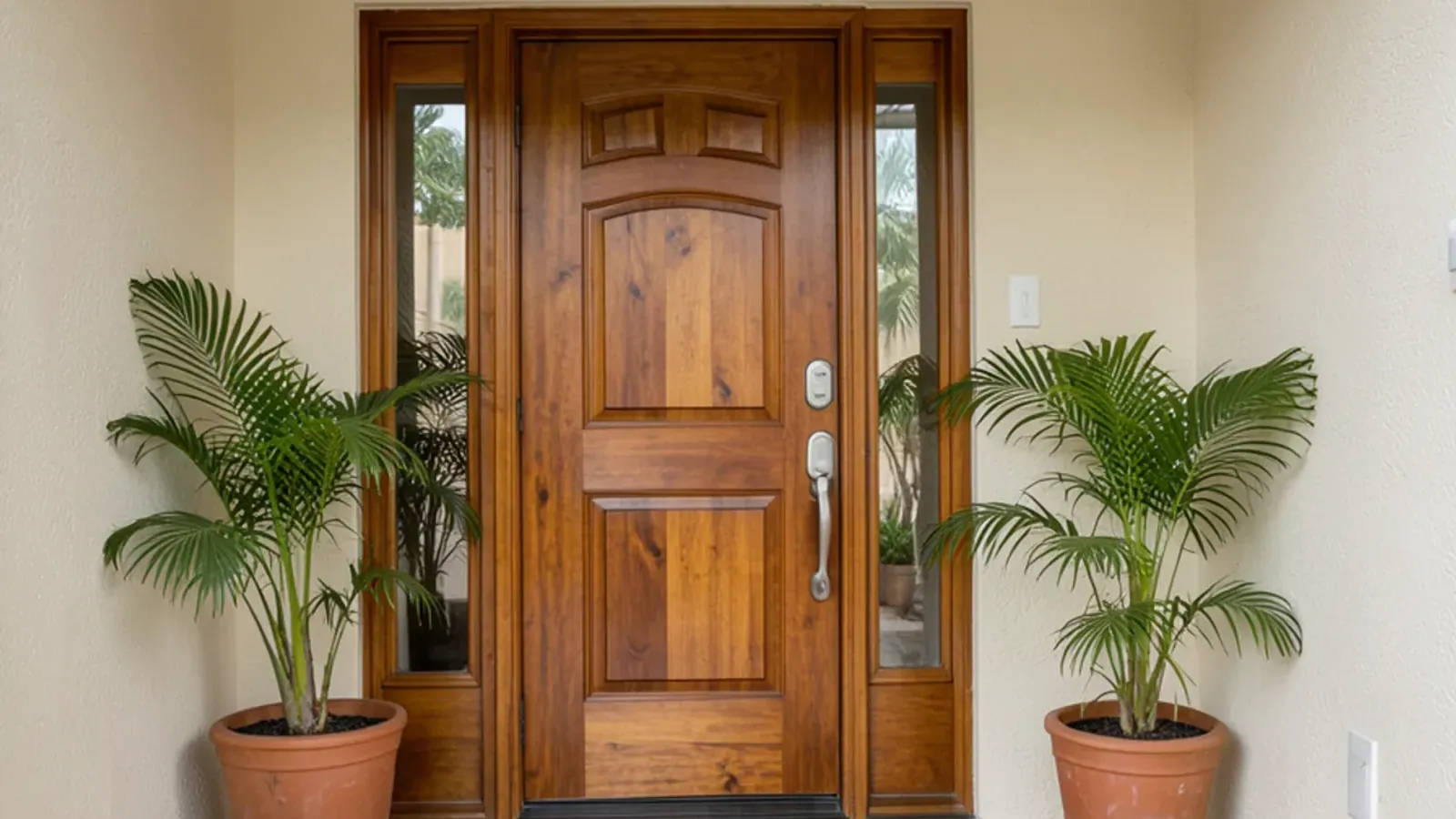
Good exterior wood door maintenance comes down to one unhurried inspection a year: check the finish for wear, tighten and lubricate the hardware, test the weatherstripping and threshold, and recoat any face that has lost its sheen. Done every year, that routine catches small problems while they are still a screwdriver and a brush, not a new door.
We build custom wood doors in our Sarasota shop, and the doors that age well are rarely the ones with the most expensive finish. They are the ones someone looks at closely once a year. Pick a dry week in late fall or winter, when humidity is lower and a fresh coat cures well, and work through the list below.
Exterior wood door maintenance, step by step
Open, close and listen
Swing the door slowly. Rubbing at the top corner, a latch that needs a shove or a deadbolt that drags all point to sag or swelling worth tracking down.
Read the finish
Look at both faces in daylight. Dullness, chalky patches, fine cracks and gray wood showing through are the stages of a finish wearing out, roughly in that order.
Check the edges
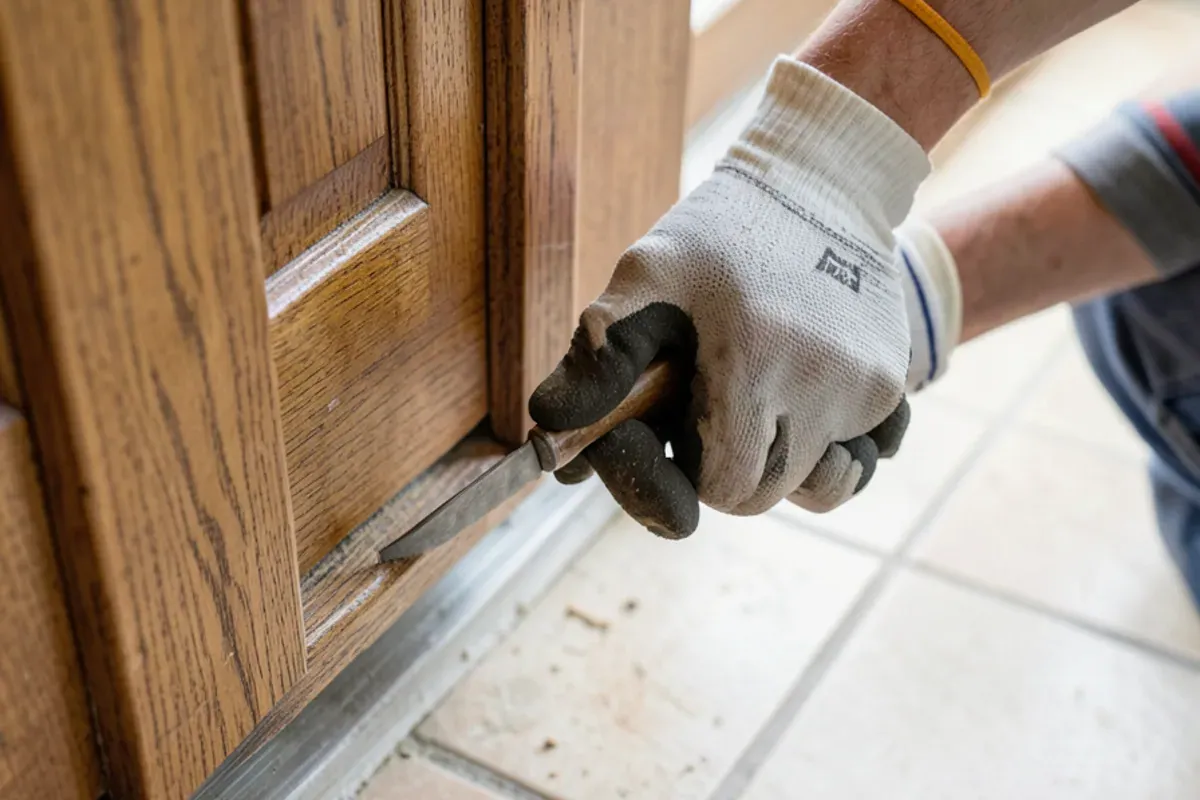
Run a mirror along the bottom edge and a hand along the top. Bare end grain on these edges drinks water and is where many doors begin to fail.
Probe the low spots
Press a fingernail or awl into the bottom rail, the panel joints and the wood around any glass. Softness there means moisture has stayed in the wood.
Test the seals
Close the door on a strip of paper at several points around the frame and pull it out. If it slides free with no drag, the weatherstrip there is not sealing.
Clean and recoat
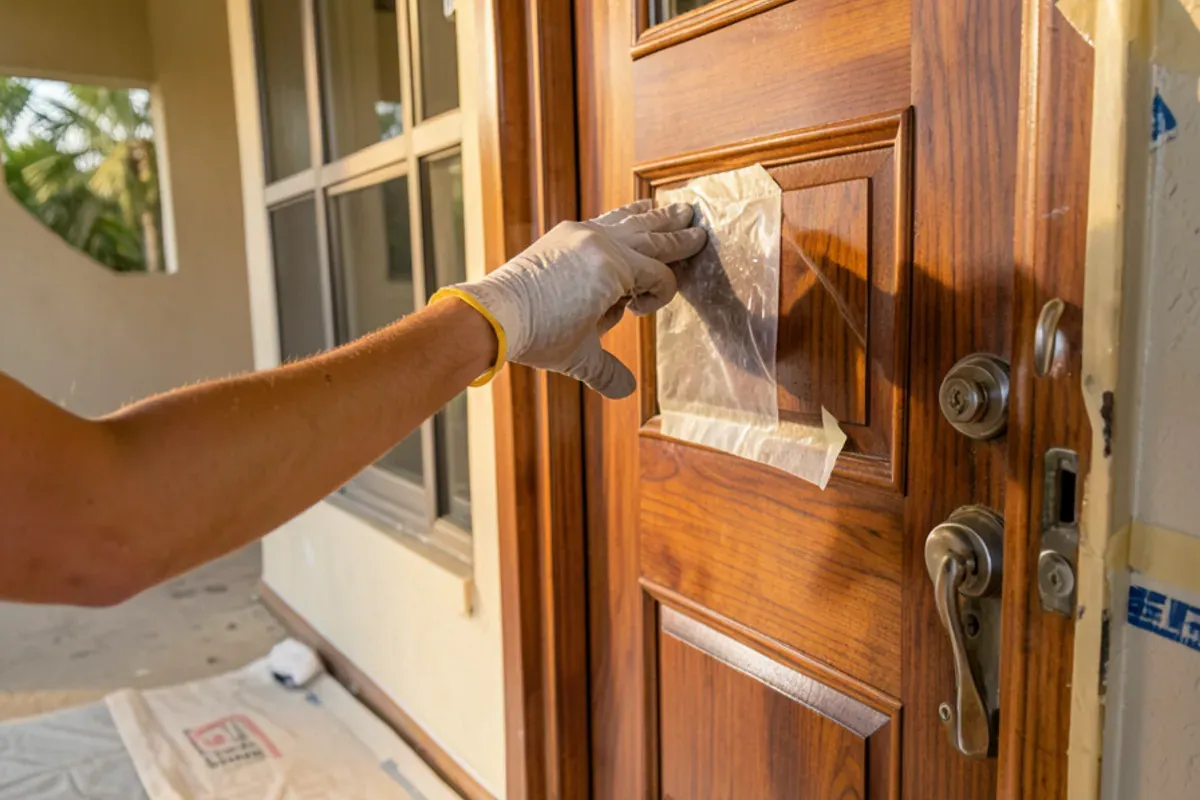
Wash the door, scuff-sand worn areas and apply a maintenance coat of the same finish before bare wood appears.
Which parts of a wood door wear out first?
Water runs down a door and collects at the bottom. That is why the bottom rail, the joints where panels meet rails, and the stops around glazing are where rot and black staining usually appear. The USDA Forest Products Laboratory's Wood Handbook notes that end grain absorbs moisture far faster than face grain, so any edge or joint that has lost its coating becomes the entry point.
Homes in Palmer Ranch often have deep covered entries that keep rain off the door, so wear shows mostly on hardware and seals. Bayfront homes in Osprey see more salt air, which is harder on metal than on a well-kept finish. Knowing which threat your door faces tells you where to look hardest each year.
Doors with glass panels or sidelights
Glass adds a weak point of its own. Rain runs down the pane and pools on the bottom glazing stop, so that thin strip of wood stays wet longer than anything else on the door. Look for a sealant bead that has cracked or pulled away from the glass, paint or varnish lifting along the stop, and dark staining in the corners. Reseal with a compatible glazing sealant before water gets behind the stop. Fog or droplets between two panes of insulated glass mean the unit's own seal has failed; that calls for a replacement glass unit, not a wood repair.
Hardware: hinges, locks and salt air
| Part | What to check | Usual fix |
|---|---|---|
| Hinges | Loose screws, a gap widening at the top of the latch side | Replace a top-hinge screw with a longer one that reaches the framing |
| Lockset and deadbolt | Stiff keys, a bolt that drags in the strike | Dry lubricant in the cylinder; adjust or reposition the strike plate |
| Strike plates | Shiny wear marks off-center on the plate | Shift the plate or file the opening so the latch drops in cleanly |
| Door closer or kick plate | Loose fasteners, corrosion around screws | Reset in fresh holes; seal the old holes so water cannot enter |
| Exposed metal near the coast | Pitting, rust bleed onto the wood | Clean, then plan replacement in stainless steel or solid brass and bronze |
One caution: if your entry is a product-approved door assembly, the Florida approval covers the unit as it was tested. Ask the manufacturer before swapping hinges, locks or the threshold for different parts.
That approval comes from Florida's product approval rule, Rule 61G20-3 of the Florida Administrative Code, which lists exterior doors among the building-envelope products evaluated against the structural requirements of the Florida Building Code. Approved products can be looked up by number on the Florida Building Commission's website, so keep the paperwork that came with the door.
Is the weatherstripping still sealing?
Weatherstripping keeps out wind-driven rain and humid air and keeps your conditioned air in. ENERGY STAR lists sealing air leaks around doors among the simplest ways to make a home more comfortable. On a wood door, check these points every year:
- Jamb seals: compression or kerf-in strips should spring back when pressed; flattened, torn or hardened sections need replacing.
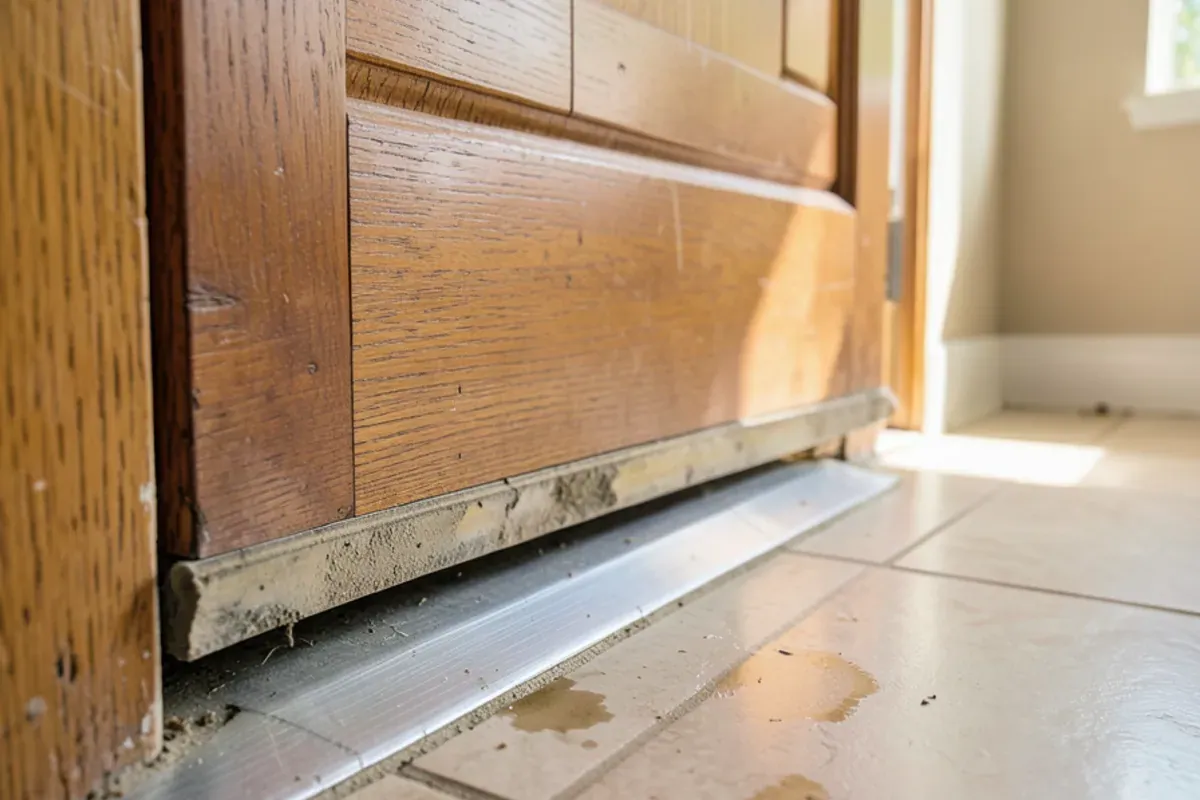
- Door bottom: a sweep or door shoe should touch the threshold along its full width with no daylight visible from inside.
- Threshold: look for a loose saddle, failed caulk at the ends and any water stain on the floor just inside.
- Corners: the top latch-side corner is where gaps open first as a door sags; pair any seal repair with a hinge check.
What should you check before hurricane season?
The Atlantic hurricane season runs from June 1 through November 30, so a late-spring look at the entry belongs in the yearly routine. A door that latches loosely or has a tired threshold is the first place wind-driven rain gets in.
- On double doors, open the inactive leaf and confirm both flush bolts slide fully into the head jamb and the sill.
- Turn the deadbolt with the door closed and make sure it throws its full length without forcing the door against the stop.
- Fit any storm panels or shutters for the opening and confirm every anchor, wing nut and track is on hand.
- Re-caulk the ends of the threshold and the joint where the sill meets the slab or tile.
- Photograph both faces of the door, the hardware and the threshold, so you have a record of its condition before the season.
When upkeep is no longer enough
A yearly routine cannot fix wood that has already rotted, a joint that has opened through the full thickness of the door, or a slab warped so far that the seals cannot close on it. At that point the choice is a structural repair or a replacement door. We look at both and tell you which makes more sense for the door, the opening and your budget.
If you decide on a new door, our finish carpentry and millwork shop can match the casing and trim around it, and every door we build starts with working drawings and a 3D model. Exterior doors also have to meet Florida's wind requirements, which we talk through before design starts.
Repairs that stop short of a new door
Between a maintenance coat and a replacement there is a middle ground, and it is where most neglected doors end up:
- Dutchman patch: soft wood is cut back to sound grain and a matching piece is glued in, then shaped and finished to blend.
- New bottom rail: when rot runs the length of the rail, the door comes off, the rail is remade and the joints are reglued.
- Reglued joints: a rail-to-stile joint that has opened is cleaned out, clamped and glued before water can travel further into it.
- Rehung door: stripped hinge screw holes are plugged with wood and redrilled so the door hangs square again.
The bottom line
An hour each year spent looking, tightening and recoating will do more for a wood entry door than any single finish product. If your inspection turns up soft wood, open joints or a door that will not seal, call us, and we will take a look and talk through repair or a new door.