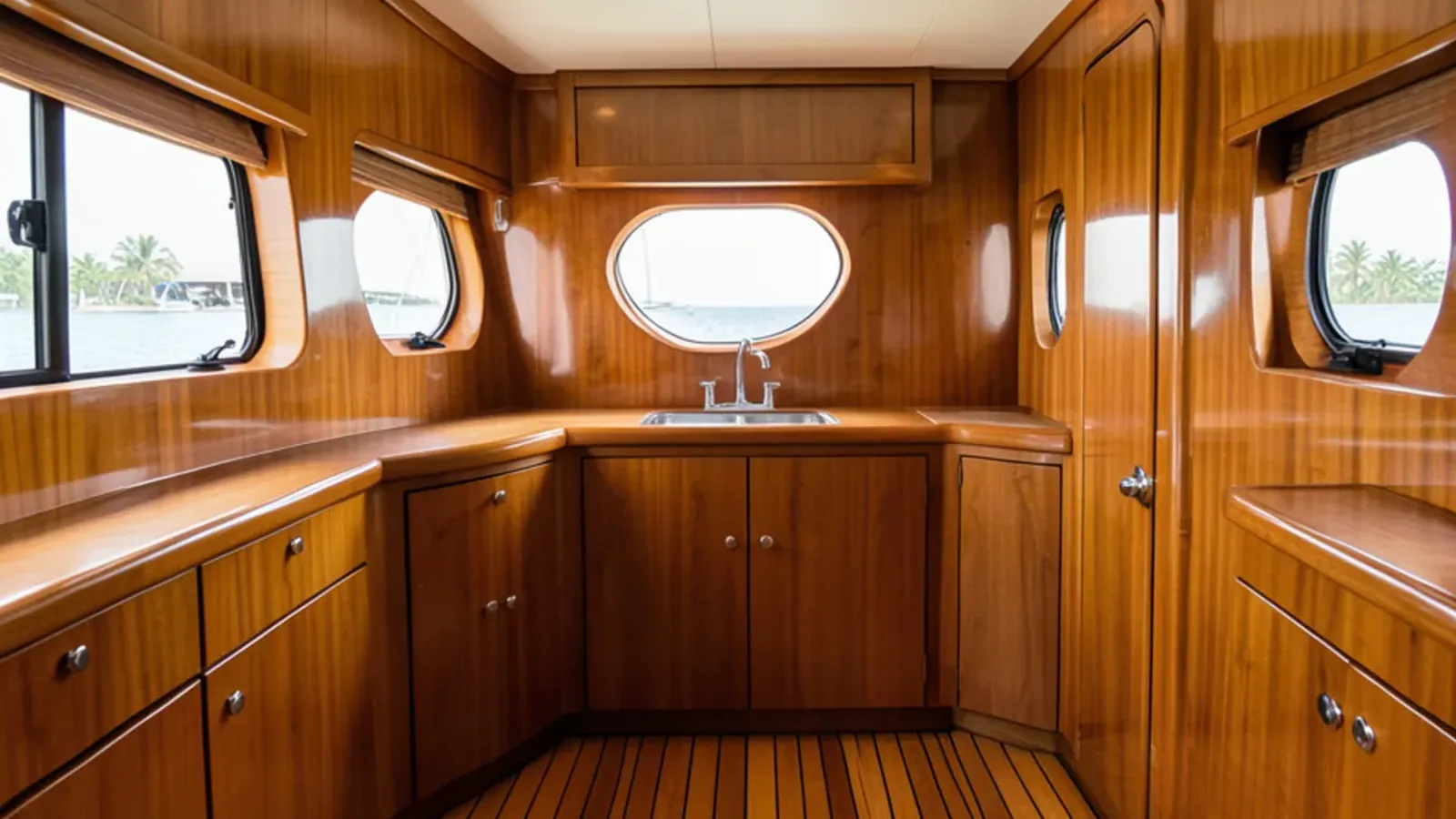
Yacht interior woodwork repair usually means three jobs: stopping the water that got past the finish, rebuilding or replacing the wood it damaged, and refinishing so the new work matches the old. Most cabin joinery, teak and holly soles and varnished trim can be repaired rather than replaced, provided the damage is caught before rot spreads into cores and framing.
Marine woodworking is part of our shop's history, from yacht interiors to teak swim platforms and brightwork. This guide explains how boat woodwork fails, which repairs make sense, and how a project moves between the boat and the bench.
Where does boat woodwork fail first?
A boat flexes, sweats and takes spray in ways a house never does. Damage almost always starts where end grain is exposed or where wood meets fiberglass, metal or a fastener. Look closely at these spots:
- Sole panels near the companionway, galley sink and bilge access hatches, where veneer lifts or turns gray
- Bottom edges of cabinet doors and bulkhead trim close to the sole, where cleaning water collects
- Bungs over screws that have popped or cracked and let water reach the fastener
- Hatch and port surrounds, where a failing deck seal sends water down the inside face
- Fiddles, grab rails and table edges worn through by hands, cleats and bags
- Cabinet latches and hinges that have loosened in soft, wet wood
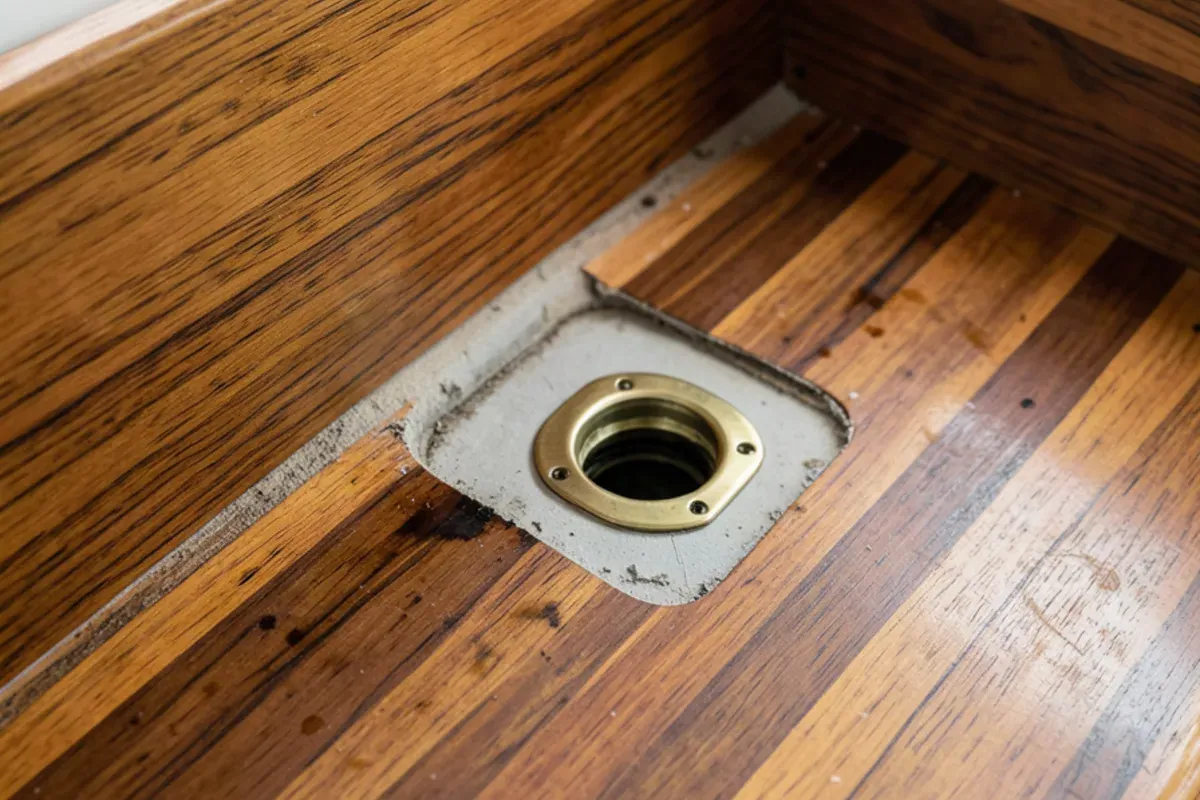
Stain, soft spot or rot? Checking before anyone sands
Dark wood is not automatically rotten wood. The USDA Forest Products Laboratory's Wood Handbook explains that serious decay needs wood wetter than its fiber saturation point, about 30 percent moisture content, which only happens when liquid water from rain, leaks or condensation reaches it; humid air on its own supports mold but not decay. For boats, the Handbook singles out rainwater from above and condensation from below, and stresses keeping fresh water out above all. That is why a weeping deck fitting does more harm to cabin joinery than spray on the hull.
- Press a thumbnail or blunt awl into the stain: sound wood resists, decayed wood dents easily or breaks short across the grain.
- Tap the panel with a screwdriver handle. A dull, dead note over part of a sole usually means the plywood core has let go.
- Look at the back face from the bilge or a locker. Damage visible on both sides has reached the core.
- Notice a musty smell in a closed locker, a sign that moisture has been sitting against the wood for a while.
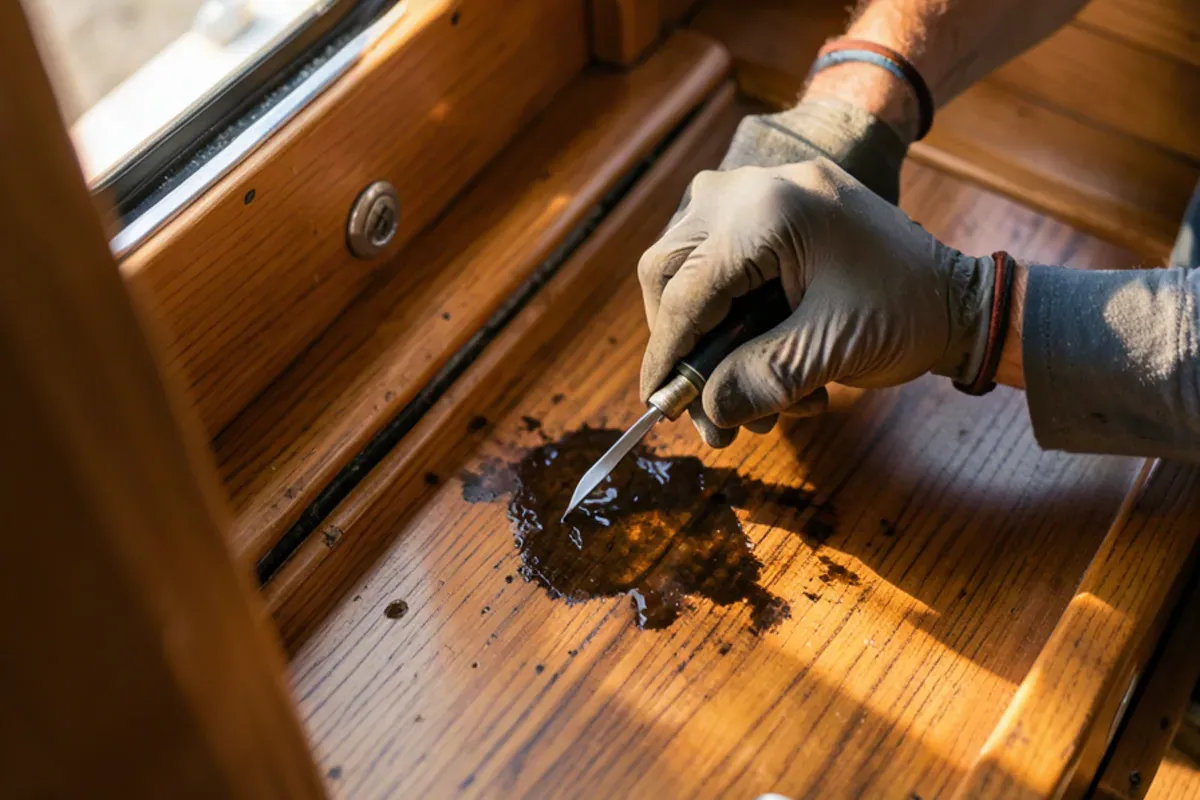
Teak and holly soles: refinish, patch or replace?
Most cabin soles are not solid teak. They are marine plywood with a thin teak and holly face, which limits how much sanding the surface can take. The decision usually comes down to how deep the damage goes.
| What you see | What it usually means | Typical repair |
|---|---|---|
| Dull, scratched finish | Wear limited to the coating | Clean, light sand and recoat |
| Gray patches or black stains | Water reached the veneer | Local sanding and bleaching if the veneer is thick enough |
| Bubbled or lifted veneer at edges | Glue line failure from repeated wetting | Reglue small areas; re-veneer larger ones |
| Soft or spongy panel | Plywood core is wet or delaminated | New panel made from a template of the old one |
| Loose hatch lifting rings or frames | Fasteners in softened wood | Rebuild the edge with new wood and reset hardware |
Whatever the repair, the source of the water has to be found first. Re-veneering a sole beside a weeping deck fitting or a leaking water tank only buys a season.
Varnished brightwork and marine finishes
Inside the cabin, wood faces humidity, condensation and spills more than direct sun, so several thin coats of satin varnish are a common, practical choice: they shed water, can be wiped clean and are easy to refresh. On deck and around ports, sunlight is the enemy. The USDA Forest Products Laboratory's Wood Handbook explains that ultraviolet light degrades the wood surface itself, which is why clear finishes in the sun need UV-resistant formulations and regular maintenance coats.
Teak walking surfaces are a different case. Boating guidance generally favors leaving teak decks and soles in heavy traffic bare or lightly oiled, because a glossy film turns slippery when wet. Soundings magazine's brightwork advice adds that dull gloss, lifting varnish and darkened wood at joints are early signals that water is getting under the coating and the spot needs attention before it spreads.
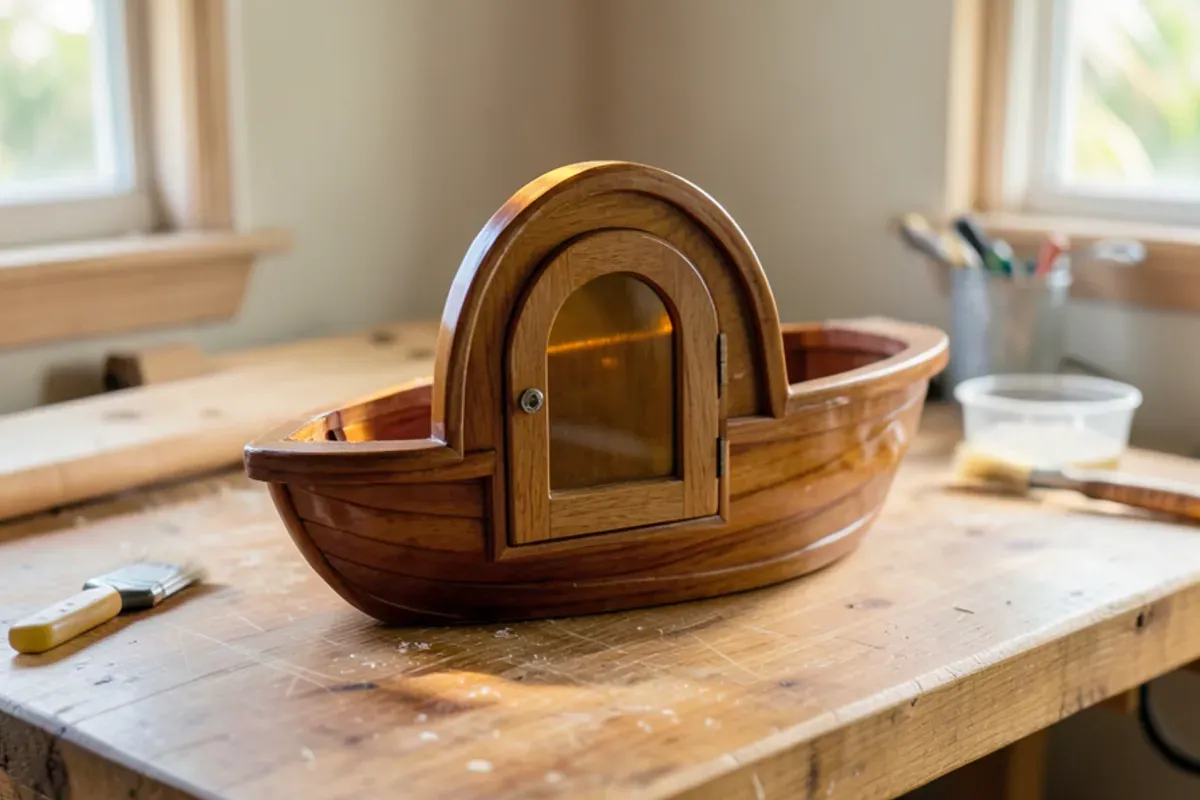
How yacht interior woodwork repair moves from boat to bench
Photos and a conversation
You send pictures of the damage and tell us about the boat, where it is kept and when you need it back.
Templates and samples
Curved bulkheads and hull-side cabinets rarely have a straight edge, so parts are templated, and we take a sample or photo of the existing finish color.
Removal
Removable panels, doors, tables and trim come off the boat. Anything tied into structure, wiring or plumbing is handled by your boatyard or the relevant marine trade.
Shop work
Repairs, new parts and finishing happen at our Lewis Ave shop, where varnish can cure without salt spray or dew.
Reinstallation
Parts go back with bedded fasteners and fresh bungs so water has no easy path into the new wood.
Where does replacement teak come from now?
Matching old teak has become a legal question as much as a woodworking one. A great deal of classic yacht teak came from Myanmar. The U.S. Treasury has sanctioned Myanma Timber Enterprise, the state body that is the only authorized exporter of Myanmar teak, and the Lacey Act, amended in 2008, prohibits importing timber harvested in violation of the law. In May 2026 the Justice Department announced guilty pleas from luxury yacht companies over Burmese teak built into yachts brought into the United States.
For an owner planning a repair, the practical step is to ask where any replacement teak was harvested and how it entered the country before it is cut. When the exact color cannot be had from a legal source, there are honest options: plantation-grown teak finished to blend, a contrasting species used deliberately for a new part, or matching stock salvaged from a hidden spot on the same boat, such as the back of a locker, for a small patch.
Will your boat project fit our schedule?
Marine work has to fit around the shop's cabinetry and furniture schedule, so we ask boat owners to call before anything else. Removable pieces, such as a galley sole panel, a saloon table, cabinet doors or a swim platform, are the easiest to take on. Full cabin refits are a bigger conversation, and we will tell you plainly whether one fits.
Owners keeping boats around Sarasota and the bayfront around Cortez can usually bring parts to the shop. Work aboard is decided case by case, based on the job and on what your marina allows outside vendors to do. Like all our finish carpentry and millwork, marine parts come from domestic and exotic hardwood stock, and we never use endangered species. We discuss alternatives when a particular teak is hard to source.
The bottom line
Boat woodwork rewards early attention: a lifted edge or popped bung is a small repair today and a rotten panel next season. If you have cabin joinery, a sole or a teak platform that needs work, call us with photos and a description, and we will tell you honestly whether the project fits the shop's schedule.
Sources
- USDA Forest Products Laboratory — Wood Handbook: Wood as an Engineering Material (2021)
- Soundings — Know How: 10 Tips for Maintaining Brightwork
- USDA Forest Products Laboratory — Wood Handbook, Chapter 14: Biodeterioration of Wood (2021)
- U.S. Department of Justice — Luxury Yacht Companies Plead Guilty to Violating the Lacey Act by Using Illegally Obtained Burmese Teak (May 13, 2026)
- U.S. EPA — A Brief Guide to Mold, Moisture and Your Home