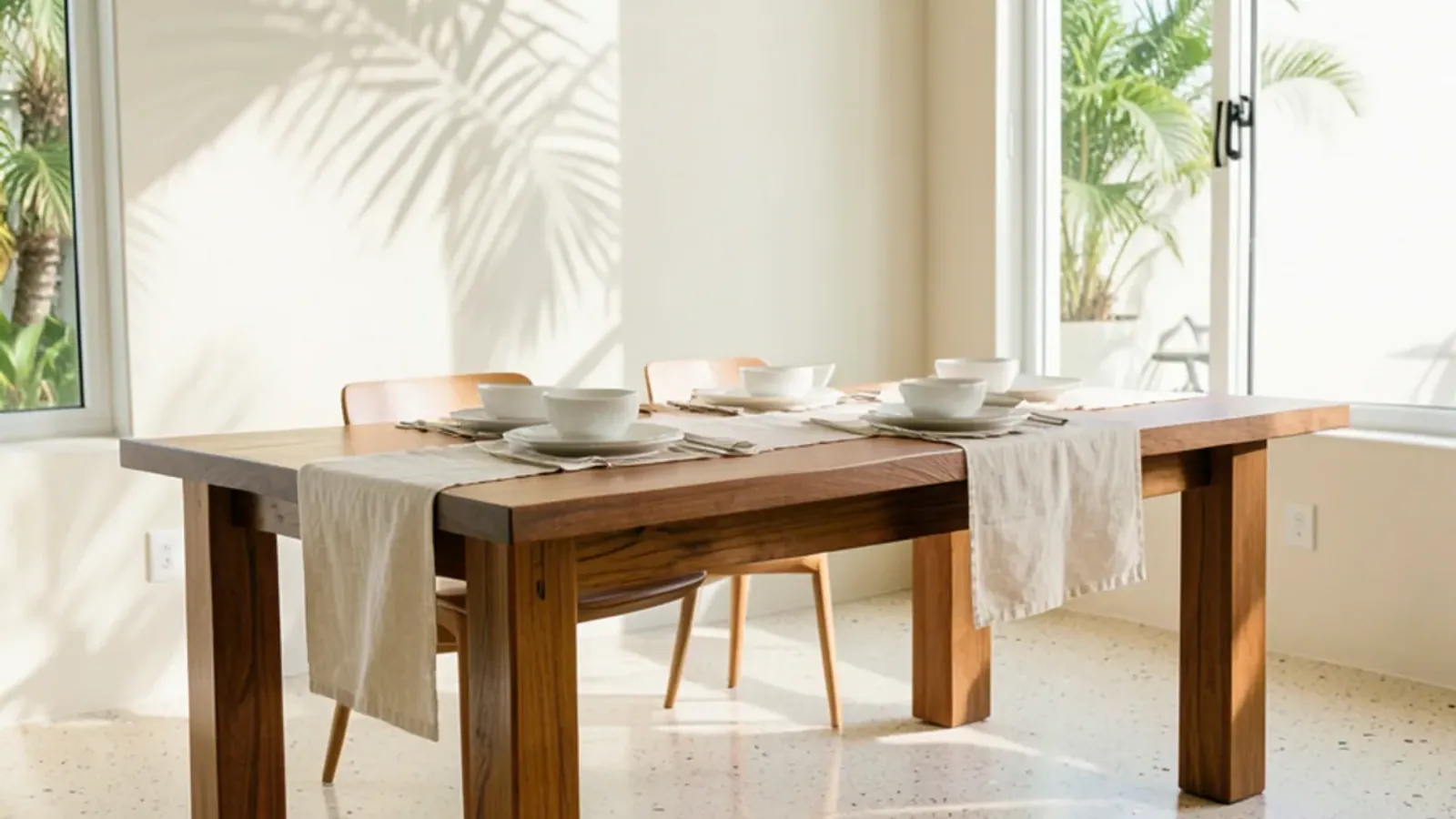
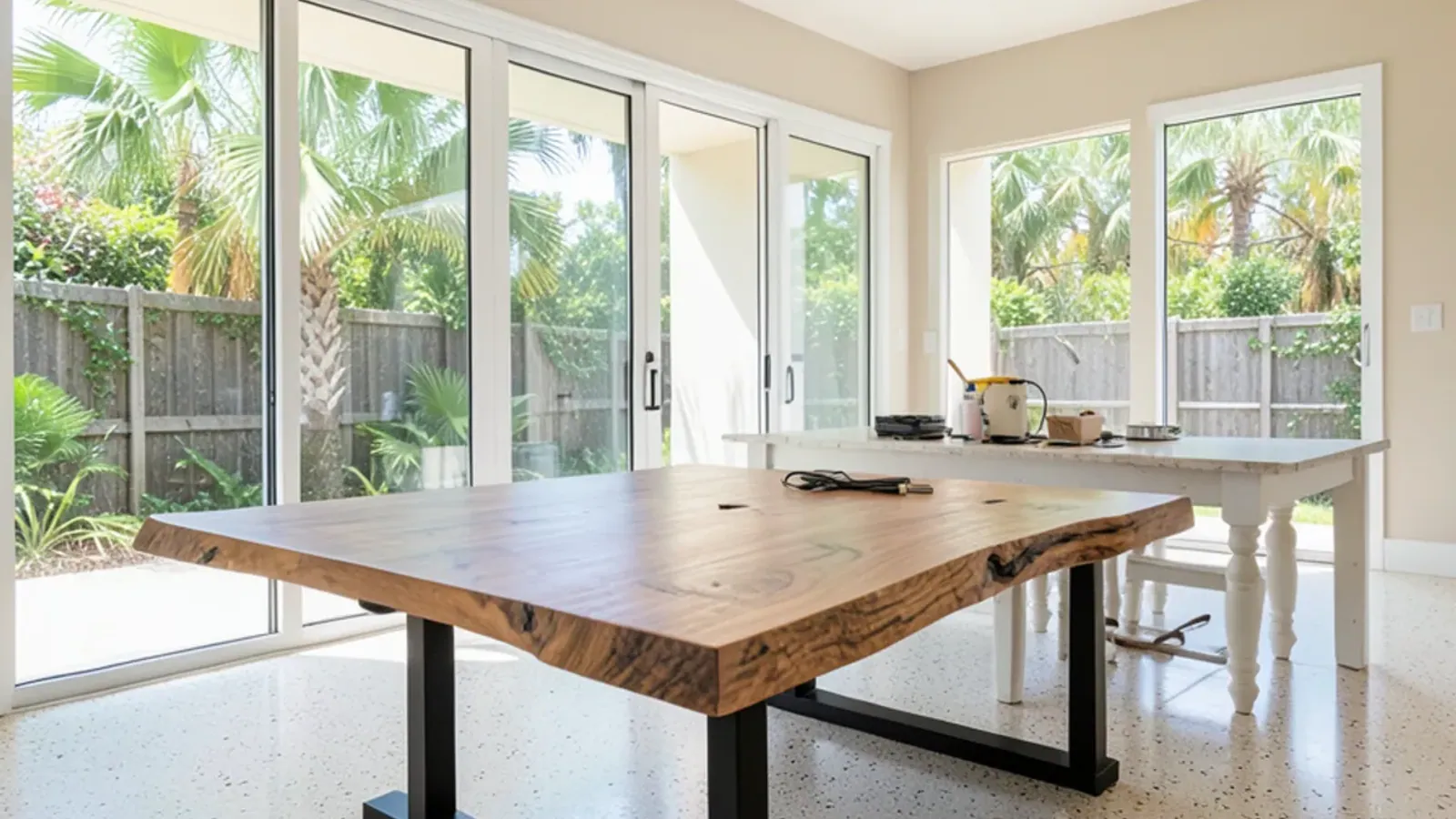
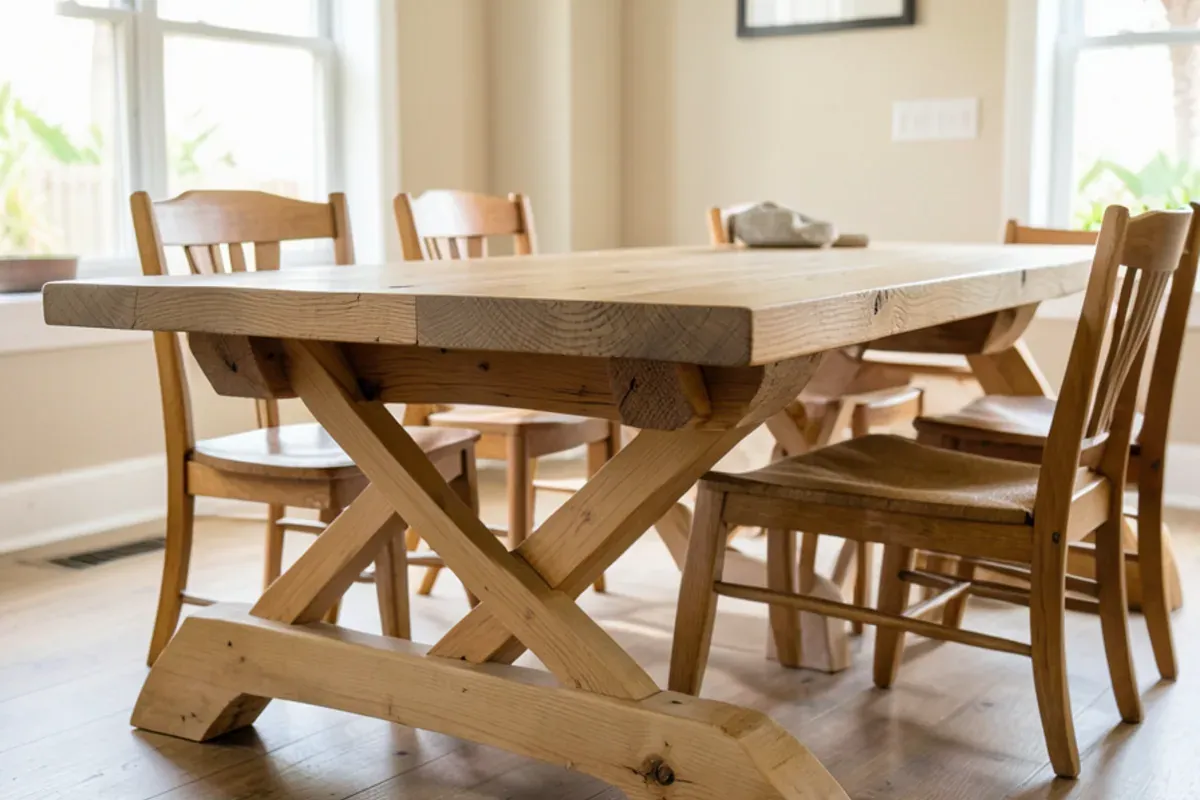
Choosing between a live edge vs traditional table is a choice between character and predictability. A live edge table keeps the natural outline of the tree, with its checks and knots, and needs drying and stabilizing. A traditional table is built from milled boards joined with classic joinery, which makes it more uniform and usually more stable through humid summers.
Both can last for generations when built properly. Below is a straight comparison from our Sarasota shop, covering how slabs are dried, how each style handles wood movement, where epoxy helps and hurts, and what each costs to own.
Live edge vs traditional tables, compared
| Live edge slab | Traditional | |
|---|---|---|
| Look | Natural edge, visible checks, knots and figure from one tree | Straight edges, matched boards, molded or eased profiles |
| Top construction | One wide slab or a book-matched pair | Several narrower boards glued edge to edge |
| Stability | Wide single piece moves more across its width | Narrower boards keep seasonal movement more even |
| Prep work | Long drying, flattening, crack stabilization, possible void fill | Milling, jointing, glue-up |
| Bases | Steel, wood trestle or glass; must allow movement | Leg and apron, trestle, pedestal |
| Extension leaves | Rarely practical | Common |
| Price drivers | Slab size, species, figure, stabilization hours | Species, size, joinery, leaves |
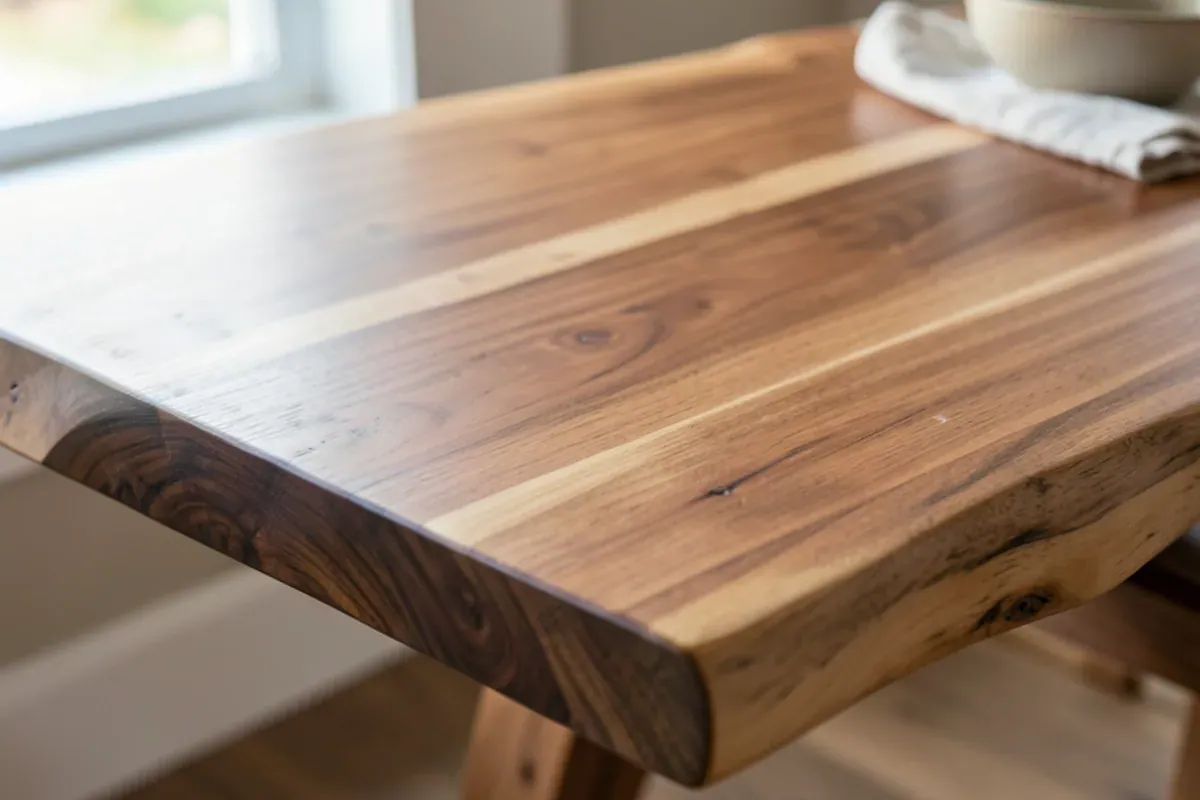
How is a slab dried and stabilized?
A slab starts life full of water. It is usually air-dried under cover with spacers between slabs, often finished in a kiln, and then left to settle in conditions close to the home it will live in. As the federal Wood Handbook describes, timber keeps swapping moisture with the room until the two reach equilibrium; a slab built into a table before reaching that point will keep shrinking and may crack or twist.
Check moisture
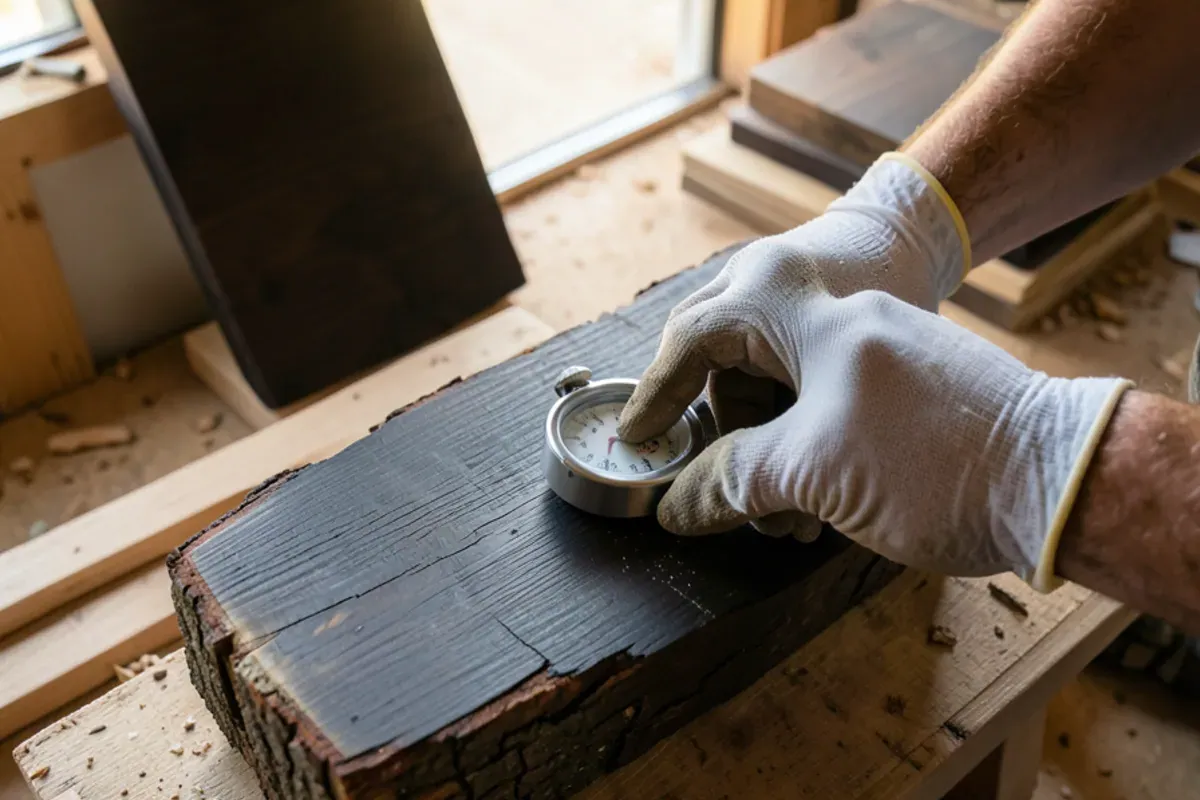
A moisture meter reading across the slab, not just at the ends, shows whether it is ready to work.
Stabilize cracks
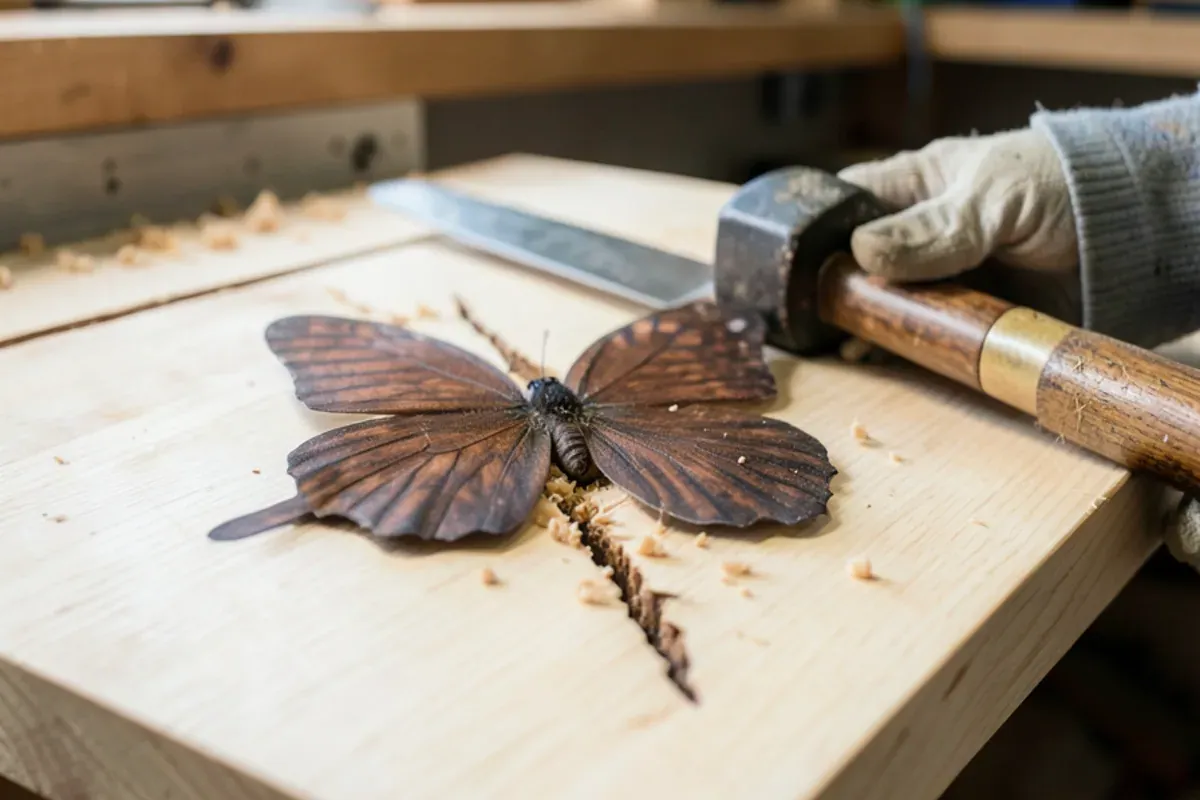
Live checks are stopped with butterfly keys set across them, and loose bark is removed or consolidated.
Flatten both faces
A router sled takes out cup and twist so the top sits flat and both faces can be finished equally.
Fill voids where needed
Small voids and knot holes are filled with tinted epoxy so crumbs and liquids do not collect in them.
Finish all surfaces
Top, bottom and edges get the same finish build so moisture moves in and out evenly.
Slabs that include the pith, the center of the tree, are more prone to splitting, and we either cut it out or plan keys around it before committing a slab to a table.
Movement in a humid Gulf Coast house
Wood shrinks and swells mostly across the grain. A forty-inch-wide slab moves as one piece, so its total movement is larger than that of a traditional top, which spreads the same change across several glued boards. Neither style should be fastened rigidly to its base: slotted holes in a steel base, wooden buttons or figure-eight fasteners let the top move without splitting.
The Wood Handbook's shrinkage table shows why ring orientation matters as much as width. Black walnut shrinks about 7.8 percent tangentially, along the growth rings, but only 5.5 percent radially from green to oven-dry; white oak runs 10.5 percent against 5.6. The handbook's rule of thumb is that tangential shrinkage is about twice the radial. A wide slab sawn straight through the log has mostly tangential grain across its face, so it carries the larger number across its full width, while a glued-up top can mix ring orientations board by board.
Seasonal homes on Siesta Key are a good example of where this matters. When owners leave for the summer and set the air conditioning high, indoor humidity can climb, and a table that was flat in February may cup slightly by August. Keeping the air conditioning or a dehumidifier running moderates the swing for both live edge and traditional tables.
Where does epoxy belong on a slab table?
Epoxy is useful in small amounts: filling knot holes, stabilizing bark inclusions and locking down punky spots. Large pours, such as the river tables with a channel of resin down the middle, are a different design with their own trade-offs.
- Clear epoxy can yellow over time under strong sunlight, a real consideration beside Gulf-facing sliders; check the resin maker's guidance on UV resistance.
- Epoxy and wood respond differently to heat and humidity, so very wide resin sections need careful design to avoid stress at the joint.
- Deep pours cure slowly and must follow the manufacturer's maximum pour depth to avoid heat buildup and cracking.
- Hot pans and serving dishes can mark epoxy surfaces; trivets are a good habit on any table.
How do you pick a slab that will make a good table?
Most slab problems can be seen before a slab is bought. When clients come to choose one, these are the checks we walk through together, slab by slab, before any outline is chalked:
- Moisture readings taken in several places across the width and along the length, not just at an end that dried first.
- Checks and splits traced to their ends, since a crack that runs into the middle of the top will need keys there too.
- Where the pith sits: a slab cut through the center of the log is the most likely to split along it.
- Thickness left after flattening. Cup and twist are planed away, so a slab that looks thick can end up thinner than expected.
- Bark and sapwood along the edges, which decide whether the live edge stays crisp or needs to be cleaned back to sound wood.
- Length and width against the room and the base, including where the legs will land relative to knots and voids.
A traditional top skips most of this list, because each board is chosen and cut separately and a flawed one is simply left out. That is part of why traditional tables are easier to plan to an exact size and schedule.
Species, sourcing and cost
Live edge tables are often priced higher than traditional ones of the same size, mainly because a wide, sound slab is rarer than the boards needed for a glued-up top and takes many more hours to prepare. A traditional table with extension leaves or an elaborate trestle can close that gap.
Some tropical timbers, ipe among them, are listed in the CITES appendices, which control international trade in protected species. We choose slabs from domestic and exotic hardwoods, none of them endangered, and a visit is the easiest way to see what is available. In Sarasota homes we often see walnut and white oak chosen for both styles.
For slab work in detail, see our live edge tables page. For the traditional side, our custom dining tables page covers sizes, extension leaves and benches, and the wider custom furniture range shows what else we build.
The bottom line
Pick a live edge table if you want the tree itself to be the centerpiece and are happy with a little natural movement; pick a traditional table if you want uniformity, extension leaves and classic joinery. Either way, call the shop or write through the contact page to arrange a visit and see the wood in person.