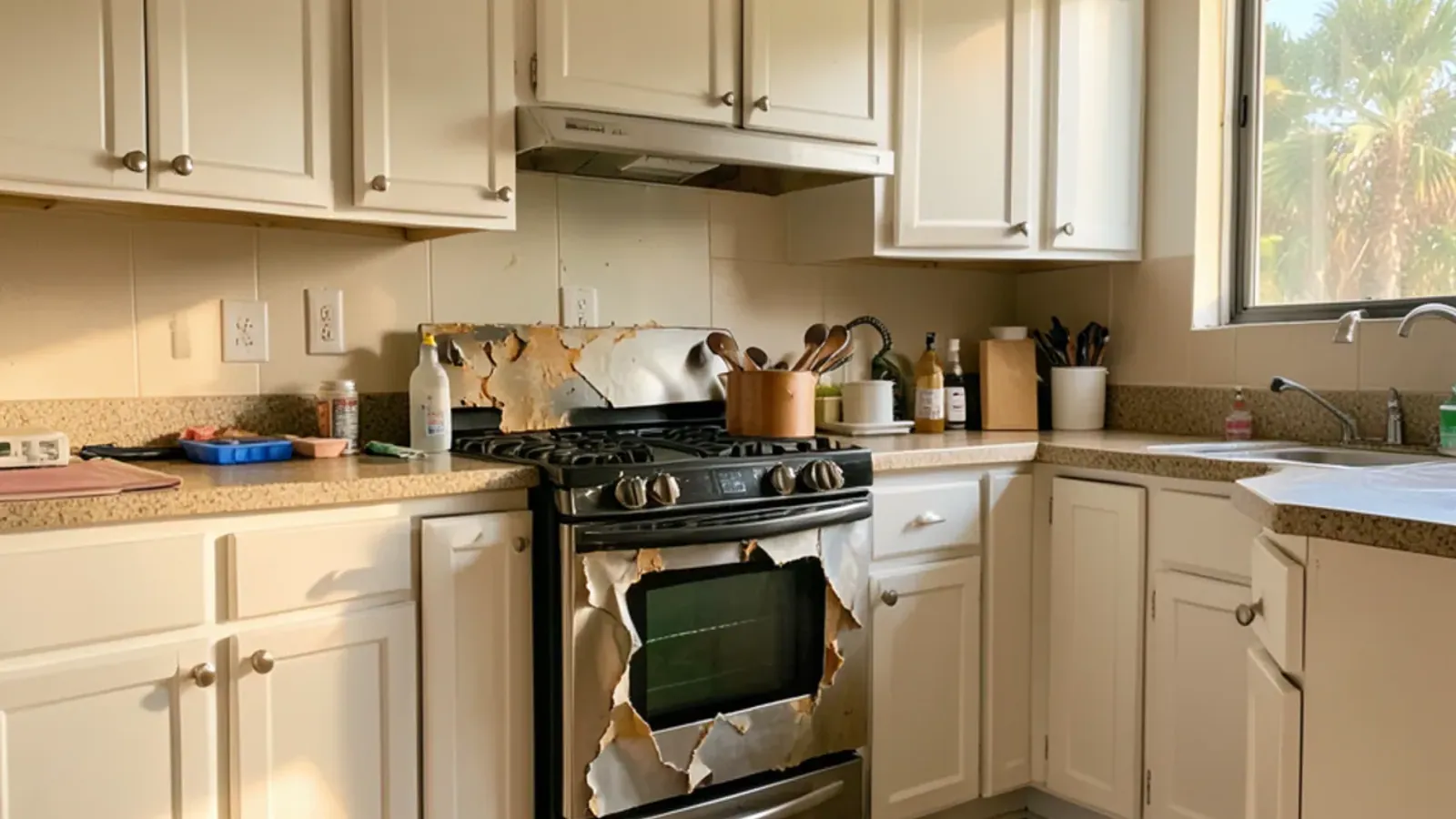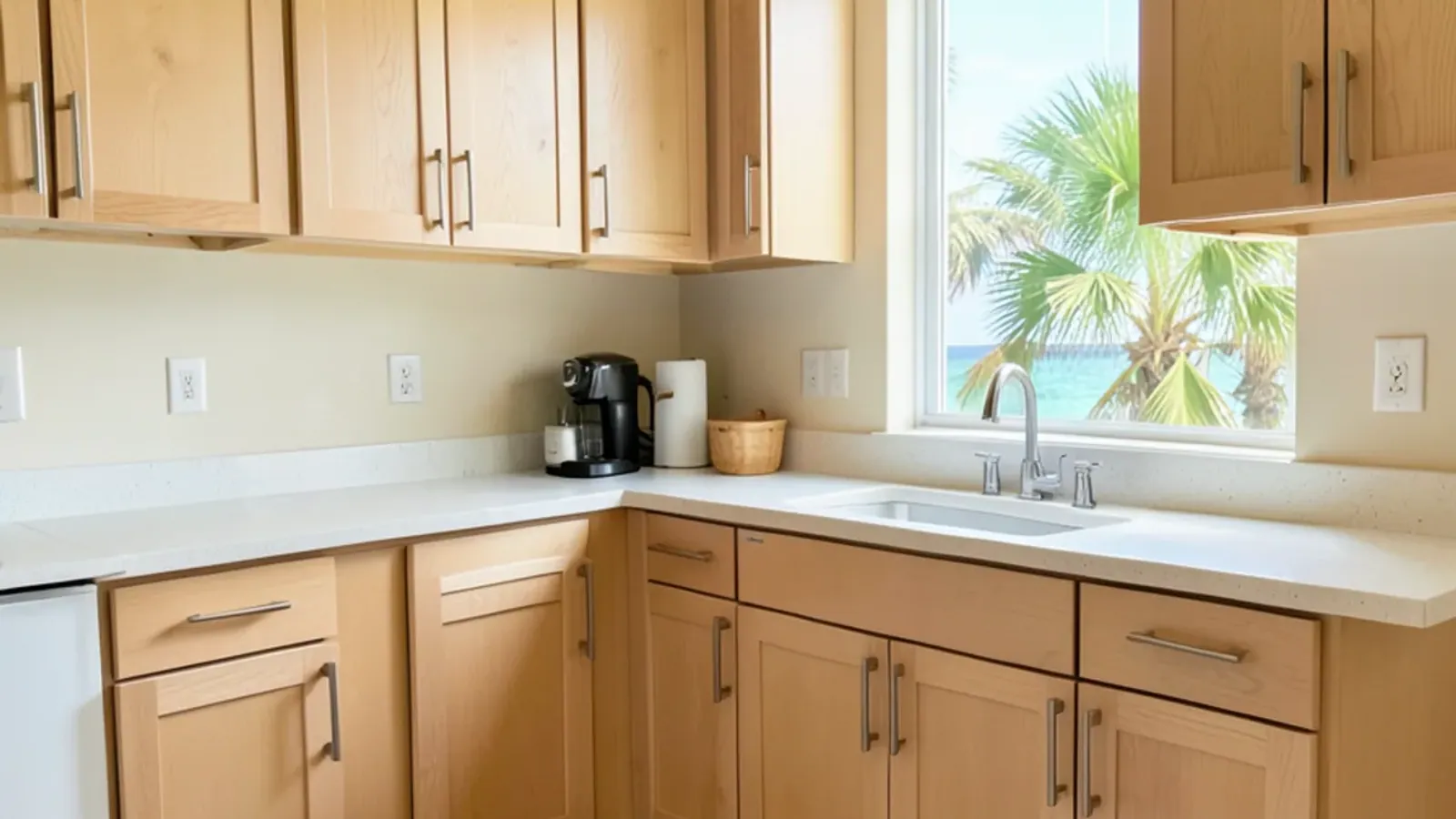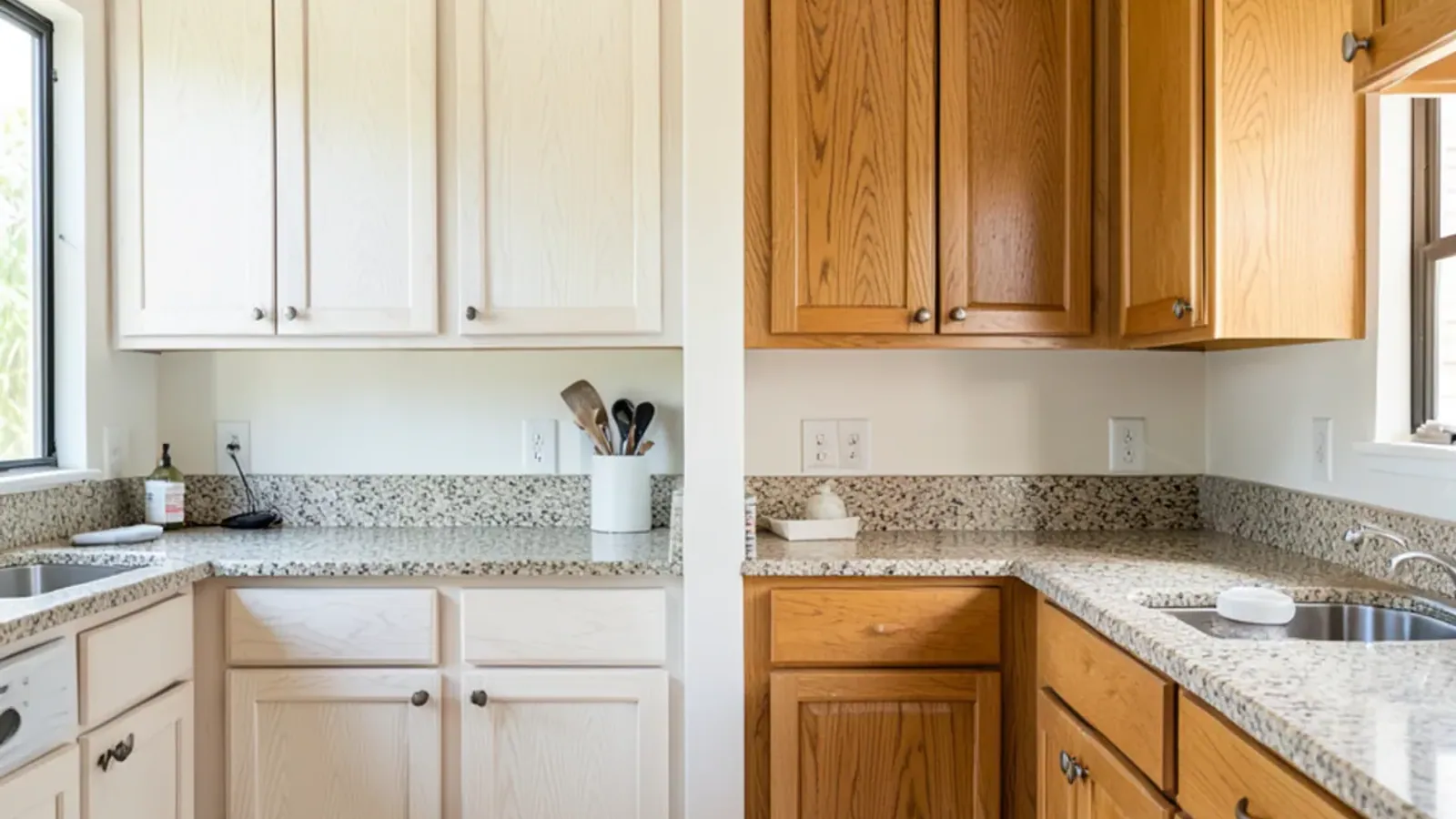
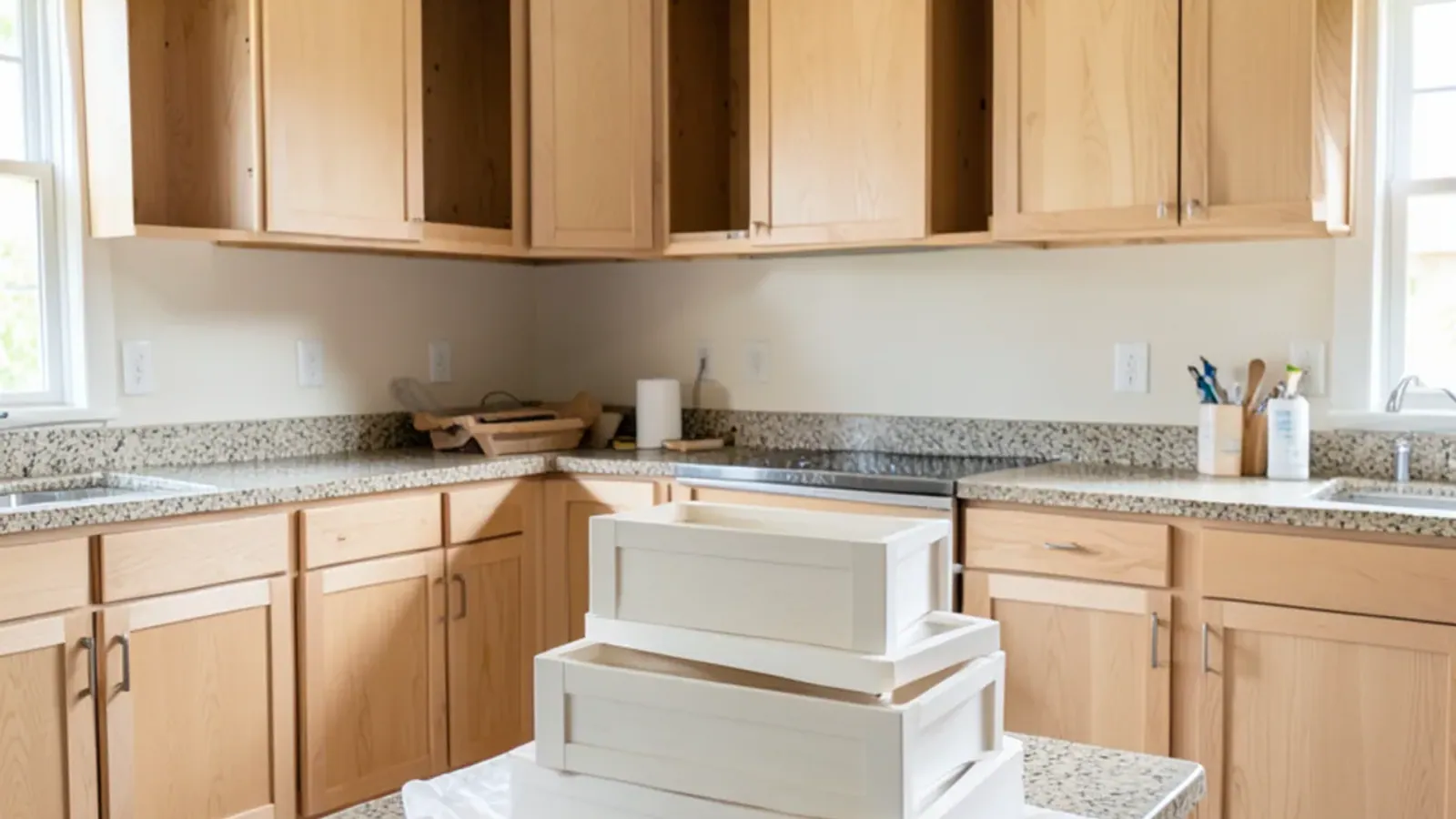
Cabinet refacing cost usually comes in well under the price of new cabinets because the most labor-heavy parts of a kitchen stay put: the boxes, the countertops, the sink and the plumbing. You pay for new doors, new drawer fronts and real wood veneer over the face frames, plus the shop hours to build and finish them.
Replacement adds demolition, new boxes, fresh countertops and reconnection work by licensed trades, so the gap grows with the size of the kitchen. This guide walks through what each option actually buys, the details that push a refacing quote up or down, a set of national survey numbers for context, and the kitchens where tearing out is the smarter spend. Fronts for our refacing work come off the benches on Lewis Ave and go into kitchens from Bradenton down to Venice.
What does each approach actually pay for?
A quote is easier to read once you know which line items exist in it. The table below lines up the two paths item by item. Count the refacing rows that read kept, stay or unchanged: each one is labor and material you are not paying for.
| Line item | Refacing | New cabinets |
|---|---|---|
| Cabinet boxes | Kept; a damaged box can be rebuilt | Built new to fresh drawings |
| Doors and drawer fronts | New, built to fit existing openings | New |
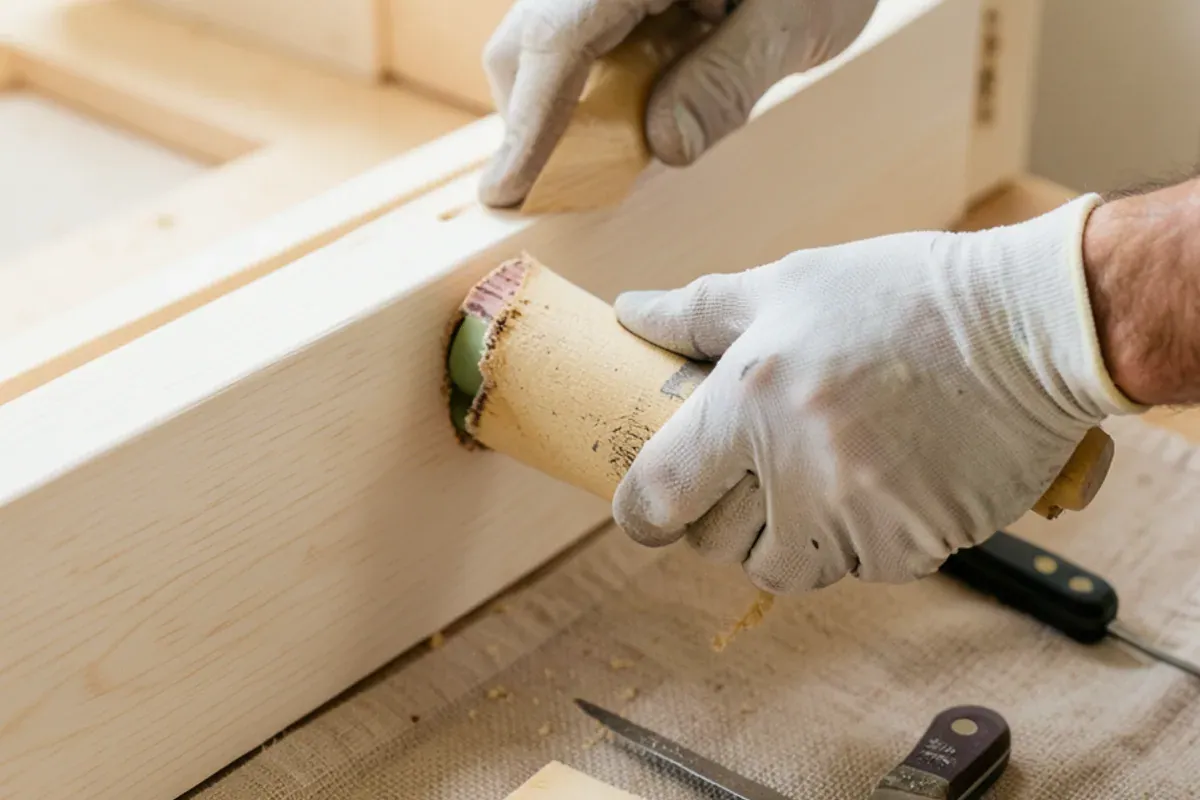
| Face frames and exposed sides | Covered in sanded, finished wood veneer | New |
| Countertops | Usually stay in place | Removed; new tops templated after the boxes are set |
| Sink, faucet and dishwasher | Stay connected | Disconnected and reconnected by a licensed plumber |
| Outlets and lighting | Unchanged | A licensed electrician handles any moves |
| Demolition and haul-away | Old doors and hardware only | Full tear-out |
| Kitchen downtime | A short install window | Several trades in sequence |
Put simply, refacing spends money on the surfaces you look at. Replacement spends money on those same surfaces and on everything behind, under and on top of them. That is why the price difference is not a fixed percentage: a kitchen with stone tops and a long run of plumbing widens it, while a small galley with laminate counters narrows it.
What drives cabinet refacing cost?
Once you decide to keep the boxes, six things set most of the number. Some are choices; one or two are simply the condition of what you already own.
- Door and drawer count. Each front is cut, joined, sanded and finished on its own, so twenty-five fronts cost more than eighteen even across the same wall length.
- Door style. A flat slab or plain shaker is quicker to build than a raised panel, and glass or mullion doors take the most bench time of all.
- Wood species. Maple meant for paint is the economical choice; quartersawn white oak or walnut, chosen for figure, costs considerably more.
- Finish. A stained and clear-coated kitchen needs color matching between veneer and solid wood. A sprayed painted finish needs primer and extra sanding between coats.
- Drawer conversions. Turning a door-and-shelf base into a stack of dovetailed drawers adds new boxes, slides and fronts.
- Box repairs and add-ons. A soft sink-base floor, new crown or light rail, and fresh hinges and pulls all add lines to the quote.
Of the six, door count surprises people most. Two kitchens can share an identical footprint and still differ by a dozen fronts, simply because one was designed with more narrow drawers. More details on how we price veneer, door styles and overlays sit on our cabinet refacing page.
Putting national survey numbers in context
Real dollar figures help, as long as you know what they describe. The Journal of Light Construction's Cost vs. Value 2025 report priced a midrange minor kitchen remodel at a national average of $28,458. Its scope is close to a refacing job: 30 linear feet of cabinet boxes stay in place and get new Shaker-style wood fronts and drawer fronts with new hardware. That same scope also replaces the range, refrigerator, sink, faucet, laminate countertop and flooring.
The same 2025 report put a midrange major kitchen remodel, which includes new cabinets, at $82,793 nationally. It estimated resale value at $32,141 for the minor project and $42,130 for the major one.
The report also breaks its numbers out by city, and Sarasota is on the list. For 2025 it put the midrange minor kitchen here at $28,579, within a few hundred dollars of the national figure, and the midrange major kitchen at $81,115. Estimated resale value ran lower in Sarasota than nationally for both projects.
| Project (midrange) | Job cost | Resale value | Cost recouped |
|---|---|---|---|
| Minor kitchen remodel (boxes kept, new fronts) | $28,579 | $29,834 | 104.4% |
| Major kitchen remodel (new cabinets) | $81,115 | $40,308 | 49.7% |
Treat the last column as a resale signal, not a verdict. The survey suggests Sarasota buyers reward a kitchen that looks fresh and works far more than they reward what sits behind the doors. If you plan to stay for many years, the boxes matter more than any resale average, and that comes down to the condition of yours.
When are new cabinets worth the higher price?
Refacing only makes sense when what is underneath deserves to stay. We recommend replacement, even though it costs more, in a handful of situations that no amount of new veneer can solve.
The first is a layout that fights you: a dishwasher wedged into a corner, no landing space beside the range, or a peninsula you want to turn into an island. The second is box construction that has already failed. Particleboard sink bases that have swollen from a slow leak, shelves that bow under dishes and backs held on with staples will not get stronger behind new doors. The third is height and depth. Taller uppers to reach the ceiling, deeper bases for modern appliances or a pantry wall all need new boxes.
Some kitchens split the difference. We can rebuild one or two problem boxes in the shop and reface the rest, which keeps the bulk of the savings while fixing the weak spot.
How do you compare two refacing quotes?
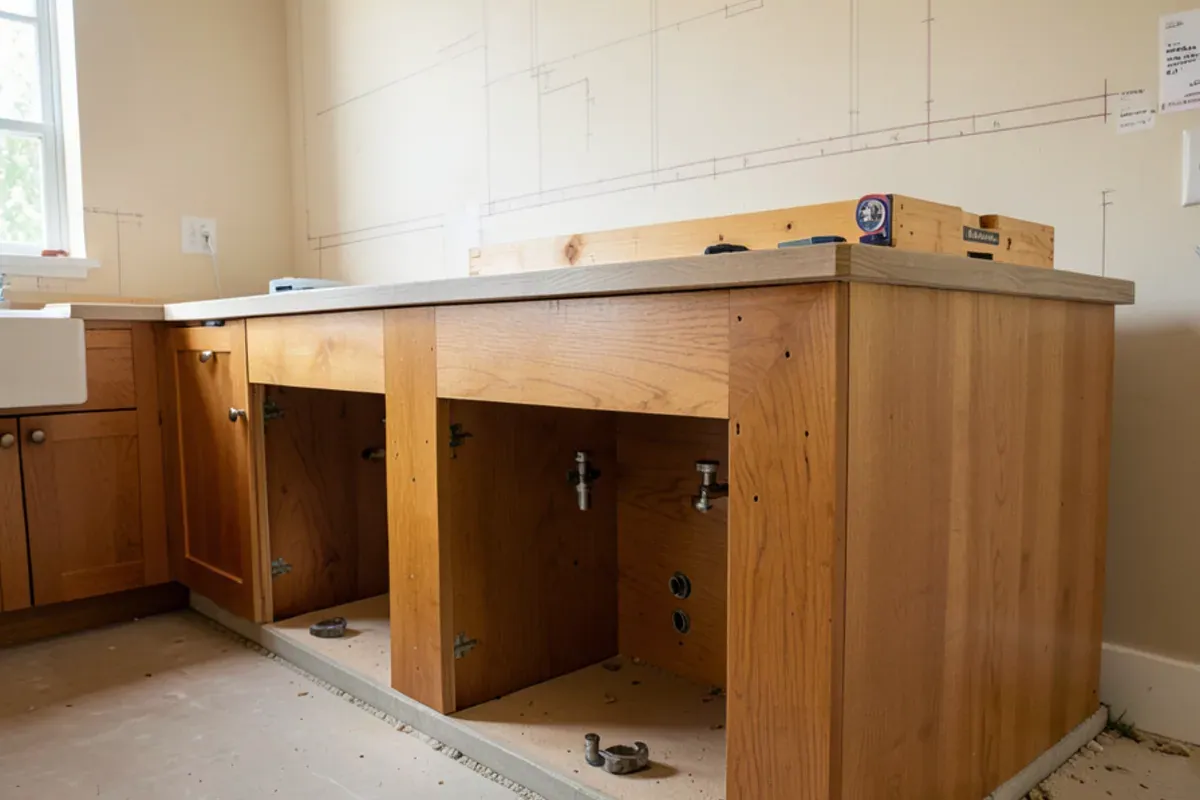
Refacing quotes vary more than replacement quotes because the word covers very different products. One company's refacing means vinyl-wrapped thermofoil doors and a printed laminate stuck over the frames; another's means solid wood doors and real wood veneer, sprayed and cured. Before you compare totals, line each quote up against the same questions.
- What are the doors made of? Solid wood frames with wood or veneered panels, painted MDF, or a thermofoil wrap. Thermofoil can lift near ovens and dishwashers, and it cannot be sanded and refinished later.
- What covers the face frames and end panels? Real wood veneer that is sanded and finished along with the doors, or a printed laminate that only imitates the color.
- How is the finish applied? Sprayed and cured away from your kitchen, or brushed on site. For a colored kitchen, our cabinet painting page explains the primer and topcoat steps worth asking about.
- Which hinges and slides are included? Concealed soft-close hinges and full-extension slides should be named by type, not lumped into "hardware."
- Are the drawer boxes new or reused? Keeping old stapled drawer boxes behind new fronts means the kitchen still feels old every time a drawer opens.
- Which box repairs are priced? A soft sink-base floor or a broken shelf support belongs on the quote as its own line, not as a change order halfway through.
- Who handles disposal and dust? Old doors, hinges and sanding dust have to go somewhere, and the quote should say where.
If the boxes and frames are fine and only the doors look tired, a smaller scope may be all you need: cabinet door replacement swaps doors and drawer fronts without veneering the frames.
Disruption, timeline and how long each option lasts
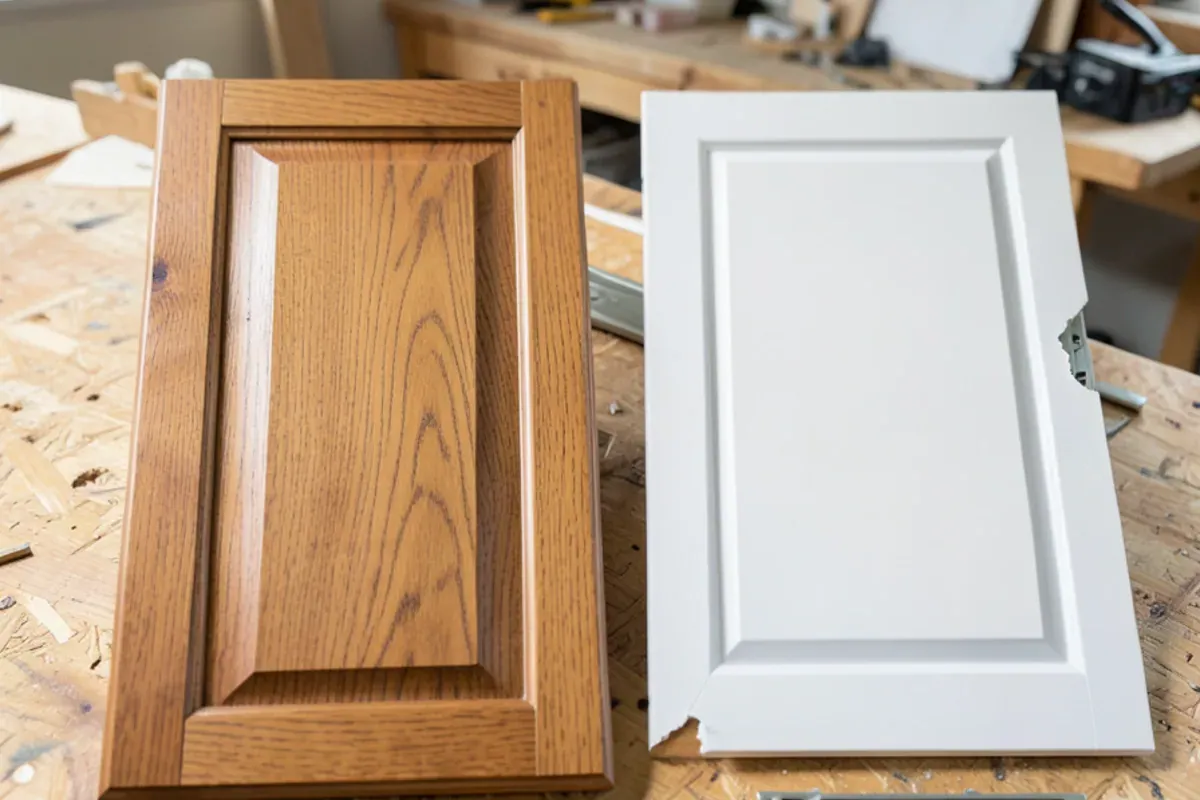
Cost is not only the invoice. With refacing, your kitchen keeps working while we build fronts at the shop; the on-site days are spent applying veneer, hanging doors and adjusting hinges. With new cabinets, the sink and counters come out, the trades follow each other in order, and you plan meals around a gap in the schedule while stone tops are templated and cut.
Longevity follows the boxes. Refaced solid-wood or plywood cabinets in good shape can carry new fronts for many years, because the parts that wear, the doors, hinges and drawer slides, are now new. Refacing tired particleboard buys fewer years, and we will tell you so at the measure.
The bottom line
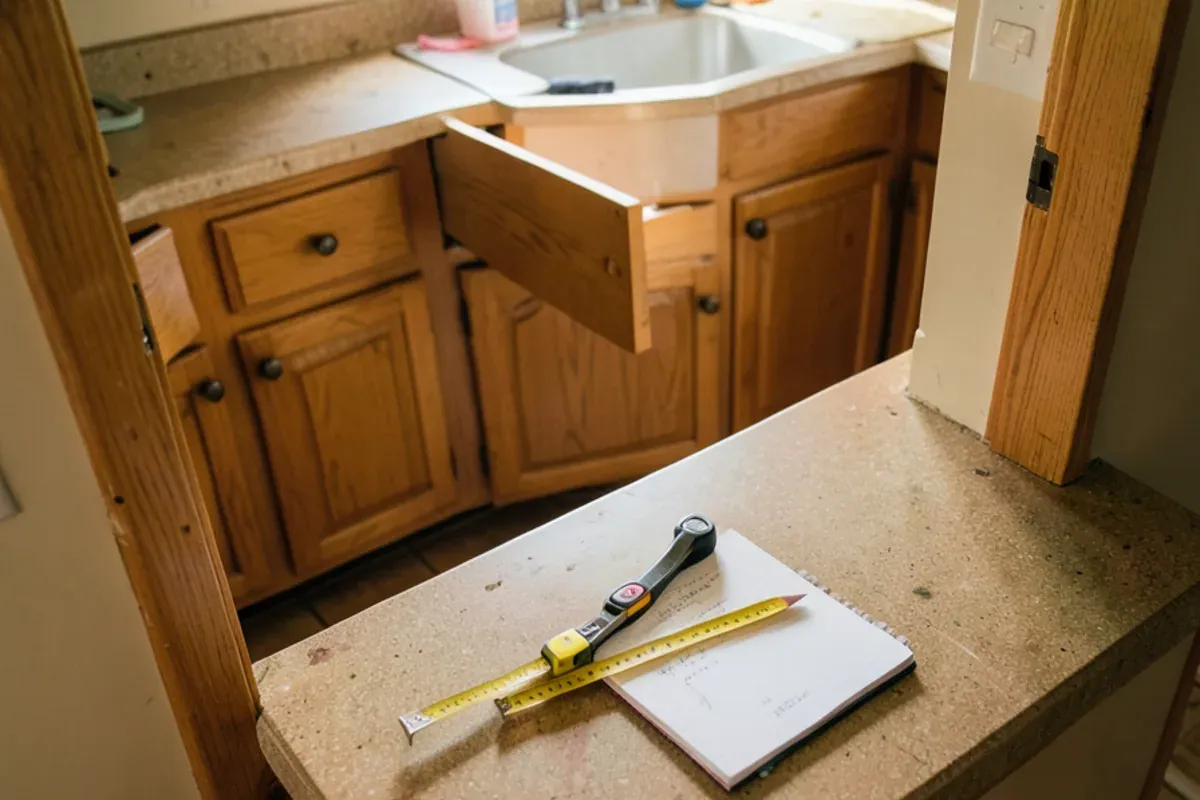
The short version: refacing costs less because it buys less, and that is exactly right when your boxes are dry, solid and laid out the way you cook. When they are not, the extra money for new cabinets goes into things you will feel every day. If you want to know which side of that line your kitchen falls on, phone the shop or use the contact form; the first step is a measure at your house, after which you see the new fronts drawn and modeled in 3D on your own walls.
Sources
- Journal of Light Construction — Cost vs. Value 2025 (national averages)
- Journal of Light Construction — National 2025 Minor Kitchen Remodel, Midrange (project description)
- Journal of Light Construction — Cost vs. Value 2025, Sarasota, FL
- U.S. EPA — Lead Renovation, Repair and Painting Program Rules
- 40 CFR 745.83 and 745.85 — RRP definitions and work practice standards (Cornell LII)